The NYT had an interesting column on the impact that the location of Amazon's new headquarters would have on rents in the finalist cities. The column reports projections from Zillow on how much more the median rents would rise over the next decade due to the presence of Amazon.
Topping the list is Los Angeles, where Zillow projected that the median monthly rent will be $740 higher in 2028 if Amazon puts its second headquarters there. This means that the median renter in the city will be paying an Amazon tax, in the form of higher rents, of almost $9,000 a year for the privilege of having Jeff Bezos company located in her city.
If Bezos chooses Denver, the median tenant will be paying an extra $720 a month, or $8,600 a year to enjoy Amazon's presence. Bostonians would have to pay $485 a month or $5,800 a year to have Amazon as a neighbor.
While this analysis is very speculative, it shows how many residents of the city "winning" the Amazon location game show could be big losers. This is especially true if the city's secret concession package costs large amounts of future tax revenue and/or commits the city to large Amazon-specific subsidies.
The point about the location of businesses and the cost of housing is an issue that comes up in other contexts as well. For example, the explosion of the financial sector in New York has sent rents through the roof there. This likely means that New Yorkers who do not derive their income directly or indirectly from the industry lose from its presence. (That would not be the case for property owners.)
It is worth noting that the piece reports Amazon says it contributed $40 million to support affordable housing in Seattle. If a new unit costs on average $200,000, this means Amazon's contribution was sufficient to build 200 units.
Stephen Snyder, at left, signs a rent control ballot measure as Zav Hershfield canvasses the Seabright neighborhood on Friday, April 20, 2018, in Santa Cruz, Calif. (Jim Gensheimer/Special to Bay Area News Group)
SANTA CRUZ — Many people in the Seabright neighborhood knew about the roiling local debate over rent control even before Zav Hershfield, petition in hand, knocked on their doors.
Canvassers for renter rights have been through parks, neighborhoods and local shopping centers since February in this coastal town, collecting signatures to place a city referendum on the November ballot limiting annual rent increases and make it harder to evict residents.
Hershfield, 25, a recent UC Santa Cruz graduate, approached homeowner Anita Grunwald while she walked her dog.
“Rent control is kind of a difficult issue,” said Grunwald, a long-time Santa Cruz resident, musing about helping the city’s population of students, teachers and emergency workers. She didn’t sign, but agreed with Hershfield on one point: “Something has to be done.”
As housing prices rise and rents soar, the tenants’ rights movement has gained momentum in smaller cities across California. Even typically placid suburbs are now grappling with rent control battles that were fought decades ago in San Francisco, Oakland and San Jose.
In addition to Santa Cruz, housing advocates in Sacramento, Santa Rosa and many Southern California communities are seeking to limit rent increases and gain protections for renters from eviction. Others, like Pacifica, San Mateo and Burlingame, have seen rent control measures fail after battles between renters and landlords.
ADVERTISING
“The pressure to keep your housing has become so intense,” said Tony Roshan Samara, program director at Urban Habitat in Oakland. “It begins to wear on individuals, families and entire communities.”
Growing financial pressure on tenants is driving a statewide push for a November referendumto lift California’s limits on rent control, a decades-old law backed by landlords and developers and known as Costa Hawkins. The law generally bans rent control on single family homes, condominiums, and units built after February 1, 1995. If the law is lifted, cities could put caps on far more properties.
Typically, local rent control measures allow landlords to annually raise rents with the cost of living index, capped at no more than 5 percent. Advocates also push for protections against evictions, limiting the reasons a landlord can remove a tenant.
Zav Hershfield, at left, talks to Anita Grunwald, holding her dog, Sandie, as he canvasses the Seabright neighborhood while looking for residents to sign a rent control ballot measure on Friday, April 20, 2018, in Santa Cruz, Calif. (Jim Gensheimer/Special to Bay Area News Group)
But across the state, real estate brokers, property owners and others have financed successful campaigns against rent control. They say the answer to the housing crisis and rising rents is more development, not regulation.
“We have found ourselves in this perfect storm,” said Joshua Howard, spokesman for the California Apartment Association. “Price controls fail to solve the underlying problem.”
Renter groups say the controls allow tenants — a growing population in many Bay Area suburbs — to have stable, predictable housing costs. The caps slow the rate of rent increases, but state law gives landlords the opportunity to raise prices back to market rates when tenants leave.
Samara said rising costs have many poor and working class families spending more than half of their income on housing. Median monthly rents for apartments in the Bay Area are among the highest in the country, with a typical two bedroom leasing for $2,270 in Oakland, $2,570 in San Jose and $3,060 in San Francisco, according to Apartment List.
The housing crisis, Smara said, “is very much a renter crisis.”
A recent study of rent control in San Francisco by Stanford researchers found the local measuresled owners to convert more units to condos or redevelop the properties, and reduced their amount of available apartments. Renters tended to stay in rent-controlled apartments longer, the study found, which allowed them to save between $2,300 and $6,600 per person annually from 1995 to 2012.
The reduced supply of apartments drove city-wide monthly prices up by about 7 percent, researchers found. They argued the program would have been more efficient if the city provided subsidies or tax credits to offset large rent increases.
Howard said property owners are willing to compromise with other provisions, such as granting relocation assistance and guaranteeing 12-month leases, but have not found a willing partner in the advocacy groups. “They had the mantra of rent control or bust,” he said.
Pacifica might offer a glimpse of what’s ahead for other suburban communities.
The quiet coastal community tucked between San Francisco and Half Moon Bay has seen its population grow and rents, like elsewhere in the Bay Area, soar. The median cost for apartments rose 51 percent between 2010 and 2015, a city survey found, far outstripping average wage increases.
A local mobile home park, Pacific Skies Estates, was purchased by out-of-state investors. The investors raised rents and renovated the property.Dozens of residents were evicted, sparking a community backlash.
A non-profit group, Fair Rents 4 Pacifica, formed and mustered enough support from the city council to get rent control placed on the November 2017 ballot.
National, state and local Realtor associations, as well as city property managers and landlords, spent about $450,000 to defeat the measure. The campaign included paid signature gatherers, signs and online marketing.
Renter rights advocates told police they were harassed by petitioners hired by landlord groups as the two sides campaigned in Pacifica shopping centers. “It was an extremely unpleasant experience,” said Suzanne Moore, a retired nurse helping lead the rent control campaign.
In March, San Mateo County prosecutors charged two contractors gathering signatures for the property owners groups with felony election fraud. Brad and Jentry Jasperson, of Utah, face 21 counts in San Mateo Superior Court of identity theft, signing fictitious or forged names to a petition, and perjury by declaration. Prosecutors allege the couple forged or made up 10 signatures of San Mateo County residents.
Zav Hershfield, at right, talks to Terry Teitelbaum as he canvasses the Seabright neighborhood while looking for residents to sign a rent control ballot measure on Friday, April 20, 2018, in Santa Cruz, Calif. (Jim Gensheimer/Special to Bay Area News Group)
Howard said the CAA supported the investigation and expects lawful behavior from its campaigners.
Tenant advocacy groups say the hardball tacticshave been mirrored in communities across the state.
Zav Hershfield expects the resistance to grow in Santa Cruz. Some members of the group are already wary of reprisals from their landlords.
As he went door to door, he said the local group, Movement for Housing Justice, was well on the way to gathering 9,000 signatures, nearly double the necessary amount to put the measure to voters. “There’s a lot of fear in the homeowner and landlord community,” said Hershfield, who rents. “I can sympathize.”
Stephen Snyder, a long-time homeowner, had already studied the issue when Hershfield handed him a clipboard.
“Everybody should have a chance to live here,” Snyder said, scratching his name on the petition.
Industrial centers like Columbus, Portland, and Wilmington are well on their way to experiencing startup revolutions.
BY BEN DICKSON Presented by JPMorgan Chase & Co.
The American tech industry has been traditionally dominated by cities like San Francisco, New York and Seattle, where the world's largest tech companies are based. However, in the past few years, as technology and connectivity have become ingrained in every part of society, cities across the U.S. have emerged as promising centers for the establishment and growth of tech companies.
America's new tech hubs are helping reshape the country's economy, creating job and business opportunities that were once only available in centralized coastal locations, a trend Steve Case coined "the rise of the rest." The rise of non-traditional tech hubs such as Wilmington, Delaware, Columbus, Ohio and Portland, Oregon, once smaller, industrial cities, showcases the critical role technology is playing in driving radical change in traditional businesses across every industry. The successful rebirth of these cities provides a window into the pivotal forces that are shaping America's economy today, and perhaps even a snapshot into what its future cities will look like.
America's new tech hubs are helping reshape the country's economy, creating job and business opportunities that were once only available in centralized coastal locations.”
To businesses and policy makers, these forces do not go unnoticed. They give cause to tech-ed initiatives like President Obama's TechHire, and the recruiting of top tech talent and acquisition of tech startups by some of the biggest non-tech companies such as General Motors, Walmart and Honeywell.
For JPMorgan Chase, tech hubs are part of a global strategy to streamline operations, recruit top tech talent and reinvest in U.S. urban communities. As part of this strategy, the company has placed 40,000 technologists across 14 global tech hubs, including locations in Columbus and Wilmington. And the timing couldn't have been better.
Wilmington: Win back your workforce
It's not uncommon for a U.S. city to experience a major industrial shift. After the departure of two chemical giants that accounted for thousands of jobs in Wilmington, Delaware, the city struggled to preserve its local talent. But as local corporations shifted their focus to technology and startup culture took root, the city has renewed its focus on workforce development to meet the opportunity head on.
Zip Code Wilmington, a nonprofit coding bootcamp launched by venture capitalist Ben DuPont with the help of JPMorgan Chase, has played a crucial role in training and re-training the city's workforce to fill the increasing number of tech jobs. The school started over four years ago when then Delaware Gov. Jack Markell sought partners to create a tech training program that aligned with the TechHire initiative. As a known tech-leader in Wilmington, JPMorgan Chase was selected to help create the program's first coding curriculum.
Since its launch, 96 percent of Zip Code's graduates found jobs in local companies, including at JPMorgan Chase, which has employed 50 Zip Code-trained software developers. "The hiring needs of companies like JPMorgan Chase are the key factor in the evolution of our curriculum and the topics and technologies we teach on a day to day basis," says Tariq Hook, Director of Education at Zip Code.
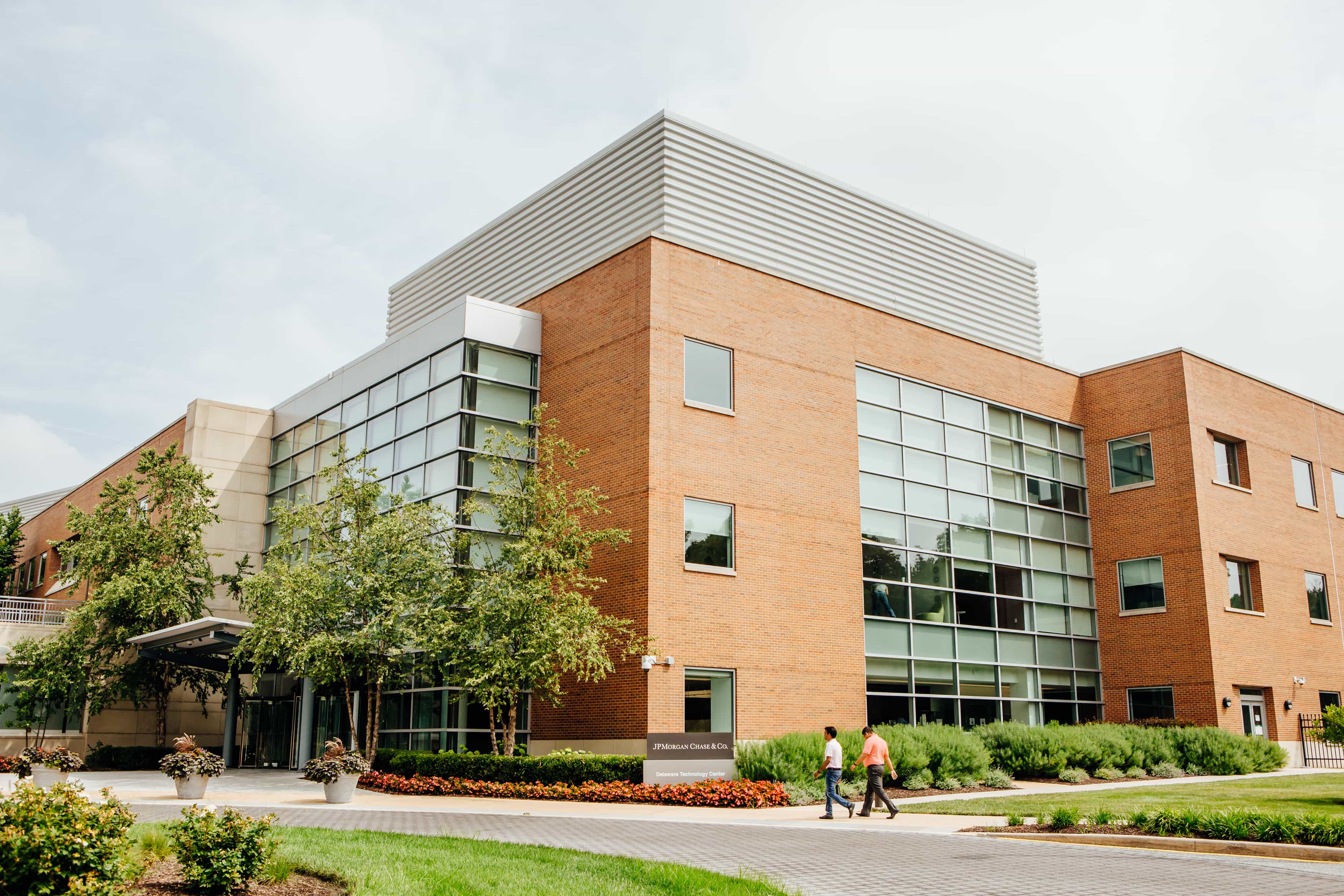
JPMorgan Chase has employed more than 50 Zip Code-trained software developers at its Wilmington tech hub.Technologists walk outside of JPMorgan Chase’s tech hub in Wilmington, Delaware. The company spends over $9.5 billion dollars in technology a year and employs 40,000 technologists across the globe.JPMorgan Chase technologists at the Wilmington tech hub work to create solutions that enhance the company’s employee and customer experience.With the help of JPMorgan Chase, venture capitalist Ben DuPont created Zip Code Wilmington (ZCW), a nonprofit coding bootcamp that is part of Gov. Markell’s Delaware TechHire initiative.“The goal of Zip Code is to have our graduates hit the ground running and provide business value by contributing from their first day on the job,” says Tariq Hook (center), Director of Education at Zip Code.Since its launch, 96 percent of Zip Code’s graduates have found jobs in local companies.JPMorgan Chase has employed more than 50 Zip Code-trained software developers at its Wilmington tech hub.Technologists walk outside of JPMorgan Chase’s tech hub in Wilmington, Delaware. The company spends over $9.5 billion dollars in technology a year and employs 40,000 technologists across the globe.
Coding bootcamps are not distinct to Wilmington, though. CourseReport, which keeps a running database, recently recorded over 100 such schools across the U.S. And the TechHire initiative claims a network of almost 240 training providers. As more and more technologies come to market, these coding schools have become a competitive source of talent for tech recruiters looking to fill new and often above-average salary positions.
Other elements of Wilmington's burgeoning startup community are 1313 Innovation, Start It Up Delaware and The Mill, co-working spaces that provide solo entrepreneurs and startups with office space. By hosting local talent and regular networking events, the incubators encourage a sense of community and culture across Wilmington's downtown area.
The city's evolving tech scene is also an opportunity for its 1,700 displaced chemical industry workers. "These people have years of experience working in highly analytical jobs, and with a slight pivot in their skill set could prove to be highly effective programmers," Hook says. "With JPMorgan Chase committing in 2015 to adding 1,800 Delaware jobs, by the year 2019, these displaced people could be re-skilled and utilized."
But other factors can make Wilmington a magnet for entrepreneurs from other parts of the country. A few hours from Washington, D.C. and New York, Wilmington is favorably positioned for anyone who wants to set up their business within easy reach of well-established tech hubs and metropolitan areas while benefiting from considerably lower costs.
What starts Columbus up
One of the key distinctions that makes a traditional tech hub traditional is its investment community. Columbus' proximity to many Fortune 500 companies, including its largest employers, Walmart, Kroger and JPMorgan Chase, has helped the city attract the investment climate it needs to make it one of the best U.S. cities in which to start a tech-based, high-growth business.
One company that grew out of this climate is MentorcliQ, an award-winning SaaS provider that helps organizations launch, support and grow high-impact employee development programs. While the founders, Andy and Phil George, both lived in California, they decided to move to Columbus to launch the company, raising $1.73 million in three rounds of funding.
"Columbus is truly a fantastic place to start a B2B business because there are so many great companies in the area," Phil George says. While MentorcliQ has customers in over 60 countries, the company has benefited immensely from being in an area that is within a day's drive of 60 percent of U.S. GDP.
Local residents and entrepreneurs meet at one of many local Columbus coffee shops.Rev1 Ventures is one of Ohio’s largest investment firms. In 2015, it received a $175,000 grant from JPMorgan Chase to help fund data analytics startups. The two also recently partnered to open the Columbus Chapter of Bunker Labs, a national nonprofit organization that supports early phase Veteran-owned startups.Local Veterans meet with members of the Columbus chapter of Bunker Labs to discuss business opportunities and receive advice. In 2016, JPMorgan Chase announced a $1.5 million national investment to help expand Bunker Labs, including the Columbus Chapter, and create more opportunities for Veterans looking to start their own business.Local residents and entrepreneurs meet at one of many local Columbus coffee shops.Rev1 Ventures is one of Ohio’s largest investment firms. In 2015, it received a $175,000 grant from JPMorgan Chase to help fund data analytics startups. The two also recently partnered to open the Columbus Chapter of Bunker Labs, a national nonprofit organization that supports early phase Veteran-owned startups.
It helps that the city is the fastest-growing city in the U.S. for startup activity. According to the Kauffman Index of Entrepreneurship, Columbus has more new businesses that grow to 50 or more employees in their first 10 years than any major metropolitan area in the country. As part of this, the city has seen a steady increase in venture capitalist activity in recent years. In 2016 alone, Ohio saw the deployment of $362 million in venture funds, and Ohio $420 million in new venture capital raised by new funds according to the National Venture Capital Association (NVCA).
Among these is Ohio TechAngel Funds, the largest angel network in North America with 340 contributors. Columbus also houses two of the state's major VC firms, Rev1 Ventures and Drive Capital - both Rev1 and TechAngel were early funders of MentorcliQ.
Columbus has more new businesses that grow to 50 or more employees in their first 10 years than any major metropolitan area in the country.”
Local leaders have played a prominent role in shaping Columbus' tech scene. In 2010, soon-to-be-governor John Kasich convinced Mark Kvamme, from Silicon Valley's Sequoia Capital, to relocate to Columbus to run economic development agency, JobsOhio. The partnership eventually led Kvamme to found Drive Capital, which launched with a $250 million fund, including a $50 million investment from Ohio State University. Drive has funded some of Ohio's more successful startups, including CrossChx and FarmLogs.
In 2015, Rev1 received a $150,000 grant from JPMorgan Chase to support startups in the data analytics cluster. More recently, the two firms partnered to launch the Columbus chapter of Bunker Labs, a nonprofit organization that supports early phase Veteran-owned startups, as part of JPMorgan Chase's $1.5 million commitment to help expand Bunker Labs across the country.
"The bottom line," says Rev1 Ventures COO and CMO Kristy Campbell, "is that startups in Ohio are only a step or two away from being able to validate their market, iterate on their product, access capital and close first customers."
Portland: College town rising
Some of the most successful startups, including Facebook and Dell, started on college campuses. In Portland, Oregon, wearable tech is leveraging the city's universities to systematically breathe life into its next big inventions.
Home to tech giants such as Intel, HP and Xerox for decades, a flourishing startup scene has recently thrust the "Silicon Forest," as Portland is nicknamed, into the limelight. It also boasts some of the country's top academic institutes.
In Portland, Oregon, wearable tech is leveraging the city's universities to systematically breathe life into its next big inventions.”
"Having access to the local universities is a huge plus," says Matthew Johnson, General Manager at APDM, a Portland-based wearables company that worked with the U.S. men's gymnastics and diving teams.
Portland is one of the most bike friendly U.S. cities with scenic pathways along the river and bike lanes across town, creating easy and active commuting options for residents.Students studying in the scenic Oregon Health and Science University (OHSU) halls. OHSU works closely with local startups on federally funded research, including ADPM Wearables, with which they have conducted over $10 million worth of projects.Portland residents enjoy their lunch hour and the city’s mild summer climate in one of downtown’s many outdoor areas.Portland is one of the most bike friendly U.S. cities with scenic pathways along the river and bike lanes across town, creating easy and active commuting options for residents.Students studying in the scenic Oregon Health and Science University (OHSU) halls. OHSU works closely with local startups on federally funded research, including ADPM Wearables, with which they have conducted over $10 million worth of projects.
Many of APDM's employees are Portland State University graduates. The company itself came out of PSU's Business Accelerator, which is home to 30 technology and science startups and is ranked among the top 25 university business incubators by UBI Global. APDM is also closely tied to the Oregon Health and Science University, with which it has conducted most of its federally funded research projects. Together, APDM and OHSU have worked on over $10 million worth of projects, mostly funded by the National Institute of Health.
Although APDM now relies on its own revenue stream, its bonds with universities still remain strong. "Being sandwiched between two universities is extremely helpful," Johnson says.
Portland continues aspiring for a tech-forward future under the leadership of its new mayor, Ted Wheeler. An advocate for infrastructure and driverless cars, Wheeler was elected on an ambitious "25-25 Jobs Strategy" that promises workforce development and wage growth - 25,000 more Portlanders with jobs paying at least $25 an hour - in the city's most lucrative fields, including health tech.
As the tech industry continues to grow at an accelerating pace, the economy and employment landscape is being disrupted in an unprecedented fashion, a disruption that has mostly benefited coastal hubs like San Francisco and New York. America's new tech hubs are providing an opportunity to distribute job growth and capital more evenly across the U.S., and to create a future where many of today's overlooked areas can become major contributors to the country's economy and centers for innovation.
The Tax Cuts and Jobs Act, signed Dec. 22, 2017, changed some laws regarding depreciation deductions.
Businesses can immediately expense more under the new law
A taxpayer may elect to expense the cost of any section 179 property and deduct it in the year the property is placed in service. The new law increased the maximum deduction from $500,000 to $1 million. It also increased the phase-out threshold from $2 million to $2.5 million.
The new law also expands the definition of section 179 property to allow the taxpayer to elect to include the following improvements made to nonresidential real property after the date when the property was first placed in service:
Qualified improvement property, which means any improvement to a building’s interior. Improvements do not qualify if they are attributable to:
the enlargement of the building,
any elevator or escalator or
the internal structural framework of the building.
Roofs, HVAC, fire protection systems, alarm systems and security systems.
These changes apply to property placed in service in taxable years beginning after Dec. 31, 2017.
Temporary 100 percent expensing for certain business assets (first-year bonus depreciation)
The new law increases the bonus depreciation percentage from 50 percent to 100 percent for qualified property acquired and placed in service after Sept. 27, 2017, and before Jan. 1, 2023. The bonus depreciation percentage for qualified property that a taxpayer acquired before Sept. 28, 2017, and placed in service before Jan. 1, 2018, remains at 50 percent. Special rules apply for longer production period property and certain aircraft.
The definition of property eligible for 100 percent bonus depreciation was expanded to include used qualified property acquired and placed in service after Sept. 27, 2017, if all the following factors apply:
The taxpayer didn’t use the property at any time before acquiring it.
The taxpayer didn’t acquire the property from a related party.
The taxpayer didn’t acquire the property from a component member of a controlled group of corporations.
The taxpayer’s basis of the used property is not figured in whole or in part by reference to the adjusted basis of the property in the hands of the seller or transferor.
The taxpayer’s basis of the used property is not figured under the provision for deciding basis of property acquired from a decedent.
Also, the cost of the used qualified property eligible for bonus depreciation doesn’t include any carryover basis of the property, for example in a like-kind exchange or involuntary conversion.
The new law added qualified film, television and live theatrical productions as types of qualified property that are eligible for 100 percent bonus depreciation. This provision applies to property acquired and placed in service after Sept. 27, 2017.
Under the new law, certain types of property are not eligible for bonus depreciation. One such exclusion from qualified property is for property primarily used in the trade or business of the furnishing or sale of:
Electrical energy, water or sewage disposal services,
Gas or steam through a local distribution system or
Transportation of gas or steam by pipeline.
This exclusion applies if the rates for the furnishing or sale have to be approved by a federal, state or local government agency, a public service or public utility commission, or an electric cooperative.
The new law also adds an exclusion for any property used in a trade or business that has floor-plan financing. Floor-plan financing is secured by motor vehicle inventory that a business sells or leases to retail customers.
Changes to depreciation limitations on luxury automobiles and personal use property
The new law changed depreciation limits for passenger vehicles placed in service after Dec. 31, 2017. If the taxpayer doesn’t claim bonus depreciation, the greatest allowable depreciation deduction is:
$10,000 for the first year,
$16,000 for the second year,
$9,600 for the third year, and
$5,760 for each later taxable year in the recovery period.
If a taxpayer claims 100 percent bonus depreciation, the greatest allowable depreciation deduction is:
$18,000 for the first year,
$16,000 for the second year,
$9,600 for the third year, and
$5,760 for each later taxable year in the recovery period.
The new law also removes computer or peripheral equipment from the definition of listed property. This change applies to property placed in service after Dec. 31, 2017.
Changes to treatment of certain farm property
The new law shortens the recovery period for machinery and equipment used in a farming business from seven to five years. This excludes grain bins, cotton ginning assets, fences or other land improvements. The original use of the property must occur after Dec. 31, 2017. This recovery period is effective for property placed in service after Dec. 31, 2017.
Also, property used in a farming business and placed in service after Dec. 31, 2017, is not required to use the 150 percent declining balance method. However, if the property is 15-year or 20-year property, the taxpayer should continue to use the 150 percent declining balance method.
Applicable recovery period for real property
The new law keeps the general recovery periods of 39 years for nonresidential real property and 27.5 years for residential rental property. But, the new law changes the alternative depreciation system recovery period for residential rental property from 40 years to 30 years. Qualified leasehold improvement property, qualified restaurant property and qualified retail improvement property are no longer separately defined and given a special 15-year recovery period under the new law.
These changes affect property placed in service after Dec. 31, 2017.
Under the new law, a real property trade or business electing out of the interest deduction limit must use the alternative depreciation system to depreciate any of its nonresidential real property, residential rental property, and qualified improvement property. This change applies to taxable years beginning after Dec. 31, 2017.
Use of alternative depreciation system for farming businesses
Farming businesses that elect out of the interest deduction limit must use the alternative depreciation system to depreciate any property with a recovery period of 10 years or more, such as single purpose agricultural or horticultural structures, trees or vines bearing fruit or nuts, farm buildings and certain land improvements. This provision applies to taxable years beginning after Dec. 31, 2017.